What should I wear on a Thames dinner cruise?
Smart casual decoded sailing by sailing: the jeans question answered, the shoes that work on a floating pier, and how cold the deck really gets month by month.
 By James Whitfield, London river and travel writer
Booking Choice
The dress code is the least demanding thing on the ticket: get the shoes and the coat right and the evening is solved. The classic three-hour sitting runs from £87 at Westminster Pier.
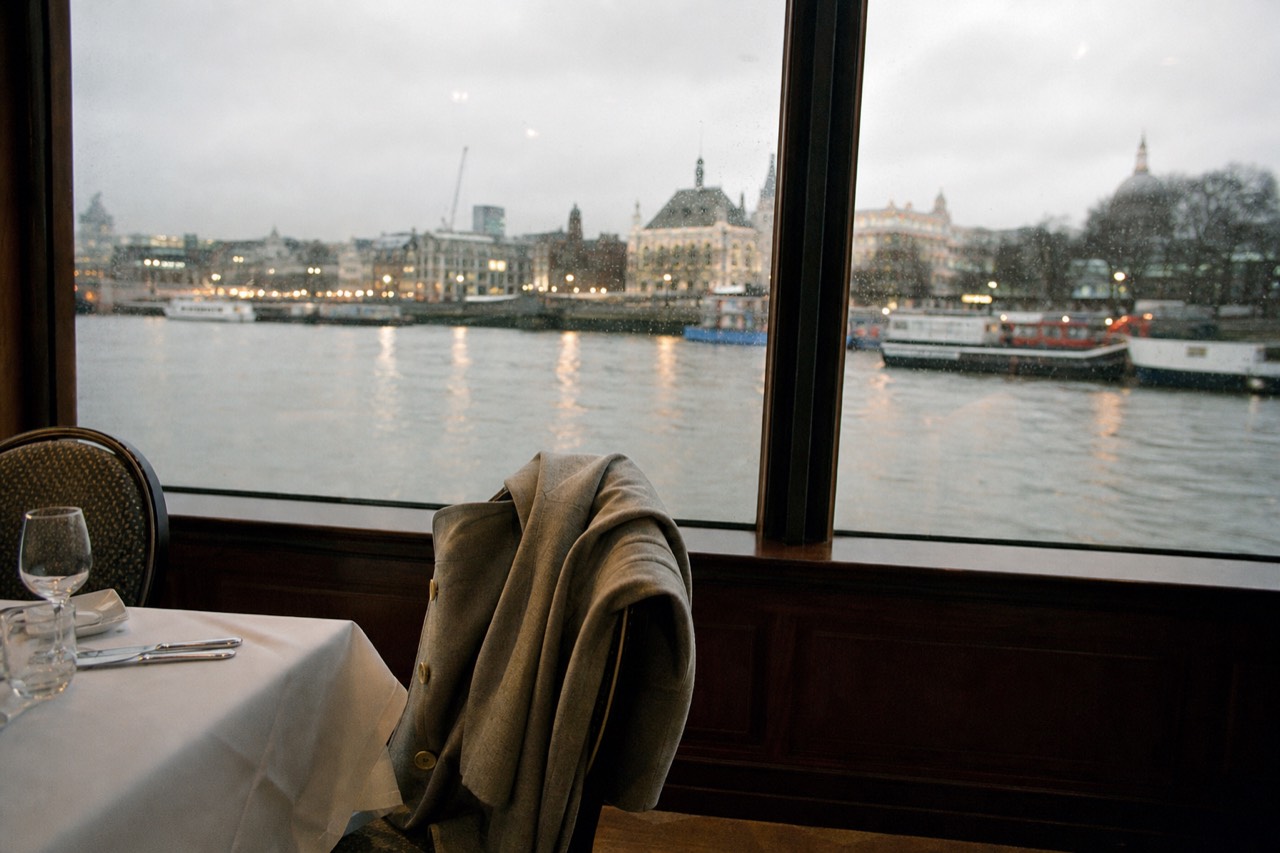
The published dress code on a Thames dinner cruise is smart casual, which tells you almost nothing. It is a phrase designed to keep sportswear off an evening sailing without frightening anyone into black tie, and every year it sends people out of a hotel room in something that looks right in a mirror and wrong on an open deck in a February wind.
The two decisions people genuinely get wrong are shoes and outer layers, and neither is about how you look. A dinner sitting is three hours long, you board over a floating pontoon whose angle changes with the tide, and the views you paid for are outside. Everything below works from those facts.
What should I wear on a Thames dinner cruise?
Smart casual: a shirt, a dress or a good top with tailored trousers, tidy flat shoes and a warm coat you can carry. Dark jeans are accepted on every scheduled sitting. Sportswear, beachwear and trainers are the only things likely to look out of place. The coat matters more than any of it, because the deck is where the views are.
The reason the dress code sits where it does is that these are public sailings with a hundred or so strangers aboard, not a private club. City Cruises publishes smart casual for the evening sittings and interprets it generously. Nobody is measured at the gangway. What actually happens is that most of the room lands somewhere between a work outfit and a night out, and a handful of people arrive dressed for an anniversary because that is what they are celebrating.
| Sailing | Published dress code | What the room actually looks like | Safest choice |
|---|---|---|---|
| Dinner cruise, £87 | Smart casual | Shirts, dresses, jackets, plenty of dark denim | Shirt or dress, coat over the arm |
| Jazz dinner cruise, £109 | Treat as smart casual | Slightly dressier, it reads as a night out | Add a jacket or a wrap |
| Elvis tribute dinner, £91 | Treat as smart casual | The most relaxed of the three sittings | Comfortable, something you can dance in |
| Evening bubbly and canapés, £35 | Not formally published | Whatever people were already wearing that evening | Smart top, warm layer, flat shoes |
| Afternoon tea cruise, £40 | Not formally published | Daytime smart, a lot of people straight off a sightseeing day | Anything tidy, plus a jacket |
| Sunset speedboat, £64.95 | Waterproofs handed out aboard | Practical, layered, hair tied back | Nothing you mind getting wet |
The one line to take away is that the dress code is not the constraint. The weather and the pontoon are. Get those two right and everything else is preference. The full breakdown of what each sitting includes, from the welcome glass to the last coffee, sits in the dinner cruise guide.
What does smart casual actually mean on a boat?
It means no sportswear, no beachwear, no muddy boots, and otherwise wear what you would to a decent restaurant. There is no jacket-and-tie requirement on any scheduled Thames sitting, no gown expectation, and no dress code enforcement at the gangway. It is a floor rather than a standard.
Smart casual on land usually means dressing up a little. On the river it means dressing sensibly, because the room you are dressing for has weather in it. A saloon with heating, a set of doors, and an open deck beyond them is a different environment from a restaurant with a cloakroom, and the outfit that works is the one that survives moving between the two a dozen times over three hours.
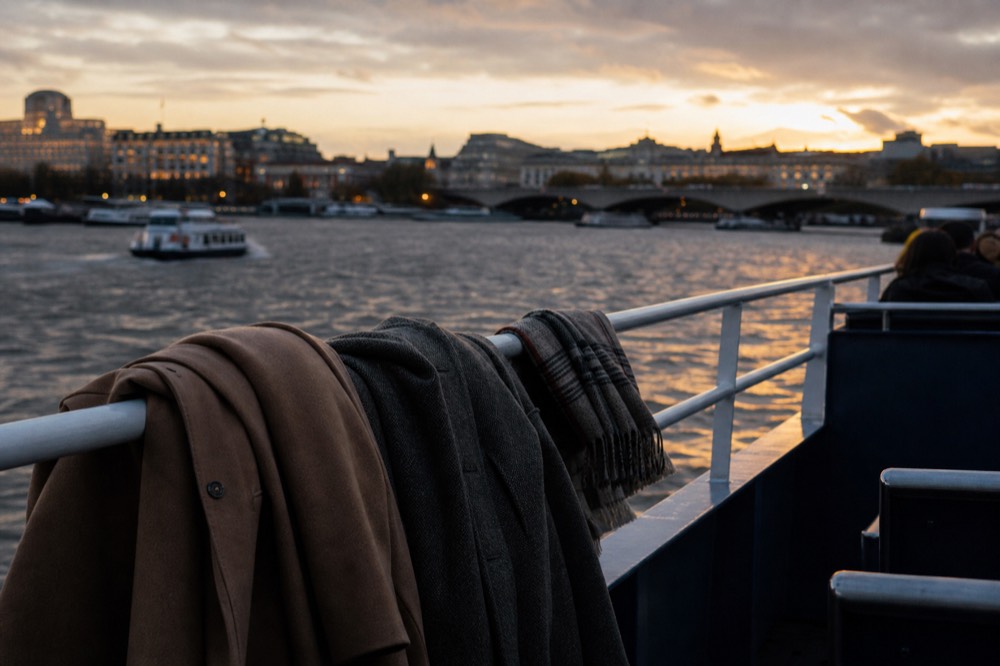
There is a practical constraint most people never think about: there is no cloakroom. Whatever you bring, you keep, either on your chair back or under it, and tables on some sittings seat four with people you have not met. A long coat and a large bag turn a comfortable table into a cramped one. Aim for one warm layer that folds small rather than a heavy overcoat you cannot store.
The other quiet limit is movement. On the standard sitting there is dancing after service, which most people do not plan for when they get dressed. On the jazz night the band is in the room and the aisles are tight. Anything that restricts your arms or makes standing up an operation is the wrong call for three hours in a fixed seat with a river going past.
If you are choosing between sittings partly on how dressed-up the evening feels, the honest ranking runs jazz, then the classic dinner, then the Elvis night, which is the most relaxed room of the three. The reasoning behind each one is set out in the after-dark comparison.
Can you wear jeans on a Thames dinner cruise?
Yes. Dark, clean, well-fitting jeans read as smart casual on every scheduled Thames sitting and you will not be alone in them. Ripped or faded denim is the version that looks out of place. Nobody is turned away at the gangway over trousers, but the room does skew tidier than a pub on a Friday.
This is the single most searched question about dining on the river and the answer really is that simple. The dress code is written to exclude tracksuits and swimwear, not denim. Pair dark jeans with a shirt, a blazer or a good knit and you are dressed correctly for any of the three dinner sittings.
The version that goes wrong is denim plus trainers plus a hoodie, which reads as a different evening entirely and stands out in a room where most people have made an effort. If you want a rule of thumb: jeans are fine if everything above and below them is not also casual.
Shorts are the genuine edge case, and they come up every July. On a hot summer evening the boat is comfortable in them and the room will contain a few, but a three-hour sitting that ends near 23:00 is a different climate from the one you boarded in, even in August. If you wear shorts, bring something for the legs of the trip after dark, because the temperature drop on the water once the sun has gone is sharper than it feels on the bank.
The evening canapé sailing is more relaxed again, partly because it is two hours rather than three and partly because it costs £35 rather than £87. That sailing genuinely takes people as they are, and if the dress question is stressing you out, it is the easier booking. You can see what the shorter evening sailing costs on your date and decide from there.
What shoes should you wear on a river pier?
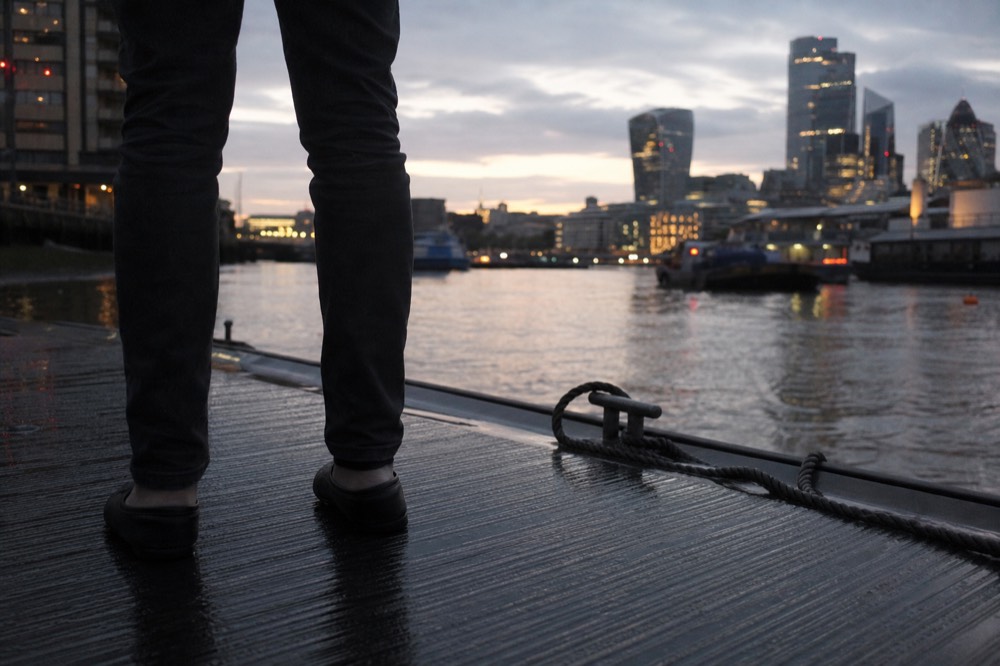
Flat, grippy and closed. You board down a gangway onto a floating pontoon, and the angle of that gangway changes with the state of the tide, so it can be almost level or a noticeable slope depending on when your sailing leaves. Add wet ridged decking after rain and heels become a real problem rather than a stylistic one.
This is the part that surprises people who have only ever boarded a boat on holiday in the Mediterranean. The Thames through London is tidal, and the whole tidal river from Teddington to the sea is overseen by the Port of London Authority. The water level under a floating pier moves a long way through the day, and because the pontoon rises and falls while the embankment does not, the brow connecting them gets steeper and shallower. One river operator gives exactly this as the reason three of its piers are not step-free: the brow can become too steep depending on the tide.
You can look up the state of the tide for your boarding time in about thirty seconds using the PLA's tide prediction tool, which is a strange thing to do before dinner and genuinely useful if you were planning on heels.
The second reason for flat shoes is the deck itself. Ridged decking, often damp, sometimes with a swell from a passing river bus, and the boat moves under you when it turns. Nobody falls over, but the people gripping the rail on the way to the bow are always the ones in the wrong footwear.
If you want the heels, the workaround is the obvious one: wear flats to board, carry the heels, change once you are seated. Plenty of people do exactly that. And if your evening starts with a walk along the river to the pier, which is the nicest way to arrive, the Thames Path national trail runs the whole way along both banks through the centre and it is properly paved, but it is still a walk rather than a stroll from a taxi.
Will you be cold on deck?
Almost certainly, if you are out there for more than a few minutes between October and April. The saloon is heated and the operator states plainly that all its boats have inside seating and are fully heated, so the cold is a choice rather than a condition. But the views are outside, and everyone goes outside for Tower Bridge.
The river is open to the east all the way to the estuary, and there is nothing between the boat and the North Sea to slow the wind down. Add the boat's own movement and the deck runs a few degrees colder than the bank, which is why people who checked the forecast still end up borrowing a jacket.
| Season | On deck after dark | In the saloon | What to bring |
|---|---|---|---|
| December to February | Cold and often windy, gloves genuinely useful | Warm, doors closed | Proper coat, scarf, gloves, warm layer under it |
| March and April | Cold once the sun goes, milder early | Comfortable | Coat you can button, something on your legs |
| May and June | Pleasant, the sailing is largely in daylight | Warm, doors often open | Light jacket or a wrap, nothing heavy |
| July and August | Mild, but noticeably cooler after 21:30 | Warm | A layer for the return leg, even in a heatwave |
| September and October | The best balance, dusk on deck and warmth inside | Comfortable | Jacket, and a scarf from mid-October |
| November | Cold, dark from the moment you board | Warm | Full winter coat, hat if you plan to stay out |
The season table has a second use, which is deciding when to book at all. From May to July a 19:45 departure spends most of its time in daylight, so the coat matters less and the lit-river photographs never happen. From September the sailing gets genuinely dark, which is what most people are picturing when they book an evening on the water, and that is when the coat becomes the most important thing you bring.
There is a wind factor people underestimate as well. The boat is making way, so even on a still evening the deck feels several degrees cooler than the pier you left, and the effect gets stronger on the return leg when you are running back upstream into whatever is coming off the estuary. Anything loose and light, a scarf, a wrap, an open jacket, spends the evening trying to leave. Something that fastens is the better call.
Layering beats a single heavy coat for the same reason it does anywhere else, with one boat-specific twist: you will go in and out of a heated saloon repeatedly over three hours, and a coat you can shed at the table without a production is worth more than a warmer one you keep wrestling with. Two moderate layers usually outperform one thick one on this particular evening.
Heat is the version nobody plans for. A saloon full of people with the doors shut on a July sitting gets warm quickly, and the sun through a window over a two-hour daytime cruise is stronger than the same sun on the bank. If you tend to overheat, dress for the room rather than the forecast and use the deck as the cooling-off option. The same logic runs through what arrives on the table, which is set out sitting by sitting in what food is served on a Thames cruise.
Does the answer change on the other river sailings?
Yes, in both directions. Afternoon tea and lunch are daytime sittings where ordinary smart clothes are right and a coat is optional. The sunset speedboat is the opposite: waterproofs are handed out aboard, it is adults only, and anything you would mind soaking is the wrong choice entirely.
Dressing for a Thames boat is really about which product you bought, and the range is wider than people expect. A £14 sightseeing circular at eleven in the morning has no expectations at all beyond a jacket in case it rains. A £109 jazz sitting on a Saturday in December is a night out with a band in it.
| The sailing | Time of day | What to wear | The thing people forget |
|---|---|---|---|
| Sightseeing cruise, £17.20 | Daytime | Whatever you are already in, plus a rain layer | The top deck is open and the river is windy |
| Lunch cruise, £36 | Midday | Daytime smart, nothing formal | Sun through glass over 105 minutes is warmer than expected |
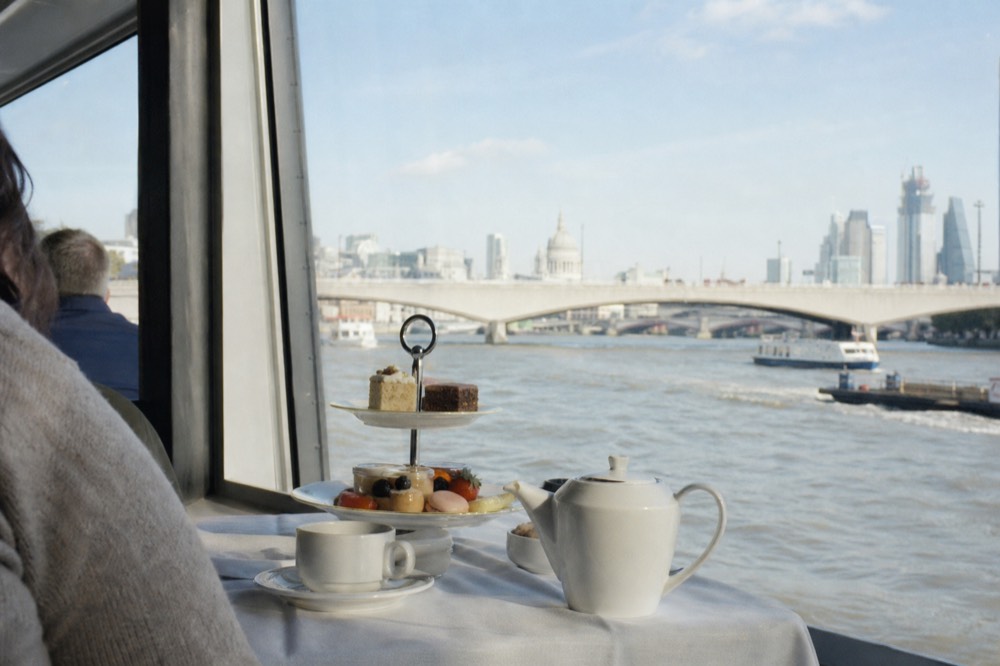
| Afternoon tea cruise, £40 | Mid-afternoon | Tidy daytime clothes, a jacket | Tables seat four and there is nowhere to put a big bag |
| Evening bubbly, £35 | After dark | Smart top, warm layer, flat shoes | Two hours outside is still two hours |
| Dinner sittings, £87 to £109 | Evening | Smart casual, coat you can carry | Nowhere to hang a heavy coat |
| Sunset speedboat, £64.95 | Golden hour | Layers under the supplied waterproofs, tied-back hair | There is no indoors on a twelve-seat boat |
The speedboat row deserves its own warning because it catches people who booked it as a scenic add-on. There is no saloon, no heating and no shelter, the boat runs at up to 30 knots, and an October evening at that speed is properly cold whatever the forecast said. The waterproofs cover your clothes and not your hands or face. The detail on those runs is in the speedboat guide, and the comparison of daytime sittings against evening ones is in the afternoon tea guide.
What is not worth bringing?
A heavy overcoat, a large bag, an umbrella and new shoes. There is no cloakroom, tables are close together, an umbrella is useless in the wind on an open deck, and three hours in shoes you have not broken in is a long evening. Everything you bring, you keep at your seat.
Umbrellas are the one people argue with. On the bank they work fine. On a moving deck with a crosswind off the estuary they turn inside out, and the practical alternative is a coat with a hood or simply stepping inside for ten minutes until the shower passes. Every dining boat on this river has an indoor saloon for exactly that reason.
Big cameras are a judgement call. A phone handles the lit-bridge shots better than most people expect, because the limitation at night is the moving deck rather than the sensor, and a bulky camera bag has nowhere to live. If photography is the point of the evening, the shorter canapé sailing gives you more deck time per pound than a three-hour sitting where you are seated for most of it.
One thing genuinely worth bringing that nobody mentions: something for your legs if you are in a dress or shorts. The temperature on the return leg, after 22:00, running upstream into the wind, is not the temperature you boarded in. That single layer is the difference between watching Tower Bridge from the rail and watching it through a window.
The last consideration is what happens afterwards. A jazz or Elvis sitting comes alongside after 23:00, and you are then walking to a station in whatever you wore to dinner, in November, at the coldest hour of the evening. Dress for the walk home rather than the table. Every sailing on Thames River Cruises is a real scheduled departure with its published return time attached, and it is worth checking the sitting time for your date before you decide what you are wearing to it.
Common questions
Is there a dress code on a Thames dinner cruise?
Smart casual, published by the operator on the evening dining sittings. In practice that means a shirt, a dress or a smart top with tailored trousers, plus tidy shoes. Sportswear and beachwear are the things it is written to exclude. There is no jacket-and-tie requirement on any scheduled sailing and nobody is checked at the gangway.Can you wear jeans on a Thames dinner cruise?
Yes, dark and clean ones. Denim is accepted on every scheduled dinner sitting and plenty of the room will be wearing it. Ripped or heavily faded jeans are the version that stands out. The safest approach is to keep everything else smart: jeans with a shirt or a blazer reads correctly, jeans with trainers and a hoodie does not.Do you need a coat on an evening Thames cruise?
From October through April, yes, and you will use it. The deck is open, the river runs east to the estuary with nothing sheltering it, and the views everyone books for are outside. The saloon is heated and the boats all have indoor seating, so the coat is what lets you choose to be outside rather than a survival measure.Can you wear heels on a Thames cruise?
You can, but board in flats and change once you are seated. Boarding means walking down a gangway onto a floating pontoon whose angle shifts with the tide, and the decking is often wet and ridged. Plenty of people carry their heels aboard and put them on at the table, which solves the problem entirely.What should you wear on a summer evening cruise?
Lighter than you would think for the first half and warmer than you would think for the second. A July sailing leaves in full daylight and comes back after 22:30, when the temperature on the water drops noticeably. A linen shirt or a summer dress with one packable layer covers both halves without carrying a coat around all evening.Get the coat and the shoes right and nothing else about the evening depends on what you wore. The dress code is the least demanding thing on the ticket.
Choose Your Thames Cruise
Start Here: An Option For This Trip
Have a travel date in mind? Choose your date to your table on the lit river before arranging the rest of your day.
3-hour dinner cruise from Westminster Pier, 4-course dinner, welcome drink and live entertainment as the riverfront lights slide past, from £87, rated 4.3 across 2,447 GetYourGuide reviews, free cancellation on most dates.
Check Dates For Dinner Cruise on the River ThamesNo verified cruise on this site matches those choices. Adjust them, or reset for the editorial recommendation.
Compare Options, Match Your Day And Estimate Costs
- Dinner Cruise on the River Thames: 3-hour dinner cruise from Westminster Pier, 4-course dinner, welcome drink and live entertainment as the riverfront lights slide past, from £87, rated 4.3 across 2,447 GetYourGuide reviews, free cancellation on most dates.
- London Showboat Dinner Cruise on the Thames: 3-hour dinner cruise from Westminster Pier, 4-course dinner with a welcome drink and live entertainment as the riverfront lights pass, from £87, rated 4.1 across 1,967 Viator reviews, free cancellation on most dates.
- Thames Jazz Dinner Cruise: 3-hour dinner cruise from Westminster Pier with a live jazz band, 4-course dinner and welcome drink, from £109, rated 4.0 across 241 GetYourGuide reviews, free cancellation on most dates.
- Thames Dinner Cruise with Elvis Tribute: 3-hour dinner cruise from Tower Pier with a full Elvis tribute set, 4-course dinner and welcome drink, from £91, rated 4.7 across 48 GetYourGuide reviews, free cancellation on most dates.
- Evening Cruise with Bubbly and Canapés: 2-hour evening cruise from Tower Millennium Pier, glass of sparkling wine, canapés and live music as the bridges light up, from £35, rated 4.4 across 2,787 GetYourGuide reviews, free cancellation on most dates.
- Afternoon Tea Cruise on the Thames: 90-minute afternoon tea cruise from Tower Pier, sandwiches, scones and pastries with tea and coffee, Tower Bridge and the Shard at slow pace, from £40, rated 4.4 across 3,823 GetYourGuide reviews, free cancellation on most dates.
Compare Your Whole-Party Costs
Enter what you would pay in the same currency for the cruise and for your alternative, including transport and meals for each.